
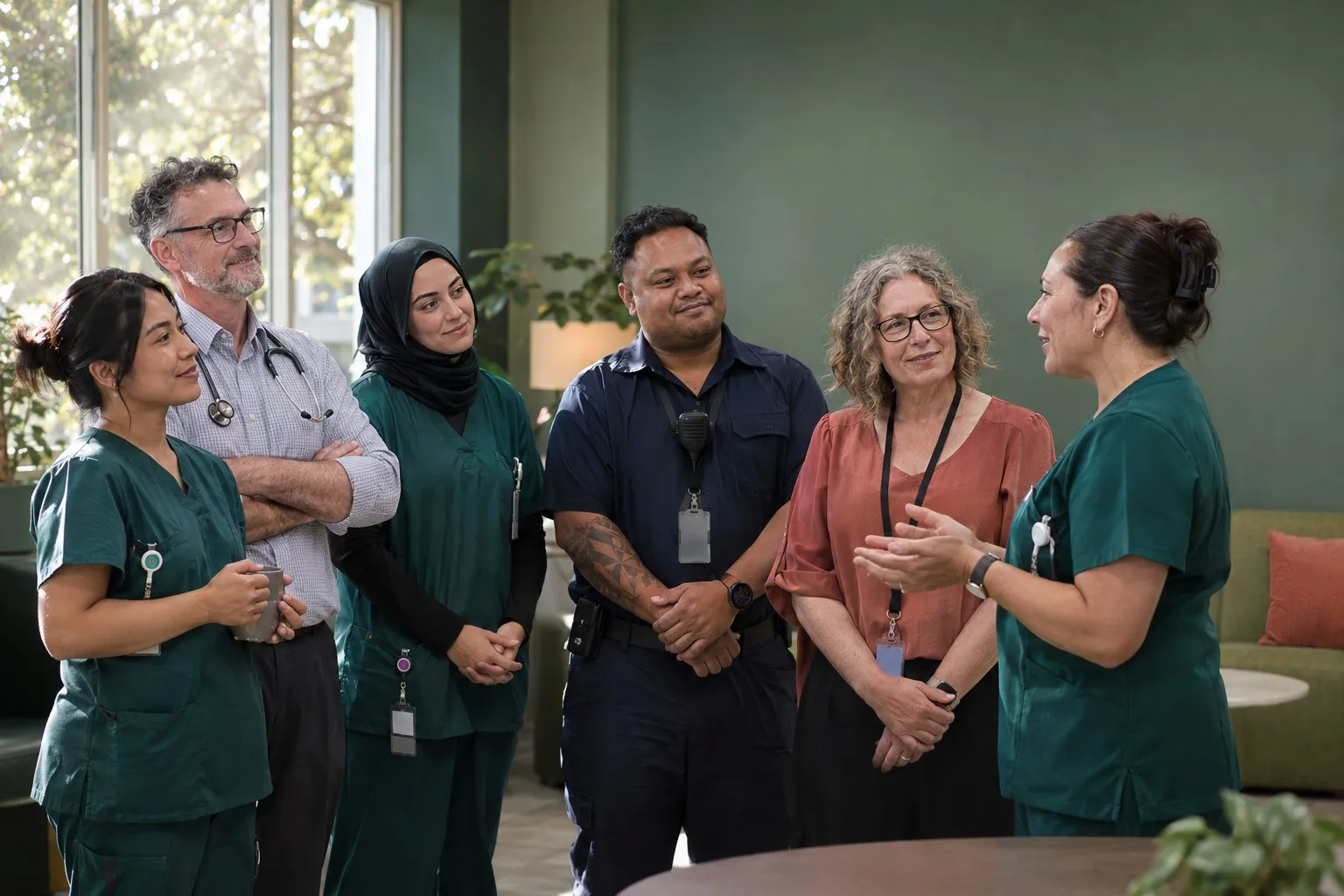
A nurse who is punched, a security officer who is bitten, a ward clerk who is threatened every shift: none of it is part of the job. Yet health workers still hear that it is, and many stop reporting it. In a 2026 survey, 88% of NSW nurses, midwives and carers had experienced or witnessed violence in six months, and only about a quarter report every incident (NSWNMA, 2026). The number of health workers hospitalised after an assault at work rose from 49 to 126 a year over a decade (AIHW data, via ACN and ANMF). The picture is the same in other states: about 80% of Queensland nurses and midwives surveyed in 2026 had experienced workplace violence in the past year (QNMU, via ABC), and Code Black calls in SA hospitals reached 15,459 in 2025, up from 13,094 in 2024 (ANMJ).
This part of the guide sets out the values case: what health workers are entitled to, what the organisation owes them, and what "zero tolerance" should mean in a place where people are often unwell. Part 2 then makes the financial case, Part 3 finds the money, and Part 4 gets it approved.
What rights does a health worker have when it comes to violence?
Every health worker, in every role, has the right to a workplace free from violence, and the law puts the duty to provide it on the employer. These rights come from work health and safety law, health policy, the criminal law and international standards. They apply equally to nurses, doctors, allied health, security officers, hotel services, clerical and support staff.
A workplace that is safe, so far as is reasonably practicable
Under work health and safety law, the employer has the primary duty of care for the health and safety of its workers (model WHS Act, s 19). That includes violence from patients, families and visitors, which Safe Work Australia names as a key hazard in health care (Safe Work Australia).
Psychological safety, not just physical safety
WHS regulations now require employers to eliminate psychosocial risks or, where that isn't reasonably practicable, minimise them, and workplace violence and aggression is one of the named hazards (psychosocial hazards code, 2022). Victoria's 2025 regulations add that training must not be the predominant control (VGSO guide).
To stop work that puts you at serious risk
A worker can cease or refuse unsafe work where they reasonably believe it would expose them to a serious risk from an immediate or imminent hazard, and health and safety representatives can direct it (WHS Act 2011, ss 84–85). In practice that right is exercised within the service's own procedures for continuing care safely.
To report, and to be supported afterwards
State health policy says it plainly. NSW Health's zero tolerance policy states that putting up with violence "is NOT an acceptable part of the job" (PD2015_001), and WA Health's policy makes de-escalation training mandatory in high-risk areas, with annual refreshers (MP 0159/21).
The protection of the criminal law
Assaulting a health worker is a crime everywhere in Australia, and some states treat it as a specific offence. Since 2022, NSW has had offences for assaulting frontline health workers in hospitals, with maximum penalties of up to 14 years for the most serious harm (Crimes Act 1900, s 60AE).
A right recognised internationally
In June 2023 Australia ratified the International Labour Organization's Violence and Harassment Convention (C190), which recognises the right of everyone to a world of work free from violence and harassment (ACTU).
Victoria's Occupational Health and Safety Act 2004 sets out equivalent duties, and each state and territory has its own WHS Act based on the model law. This is general information, not legal advice.
What does zero tolerance actually mean?
Zero tolerance means zero tolerance of violence, not zero tolerance of people. NSW Health defines it as taking action, as far as reasonably practicable, to prevent violence, while making sure clinical services continue in a way that keeps patients, staff and others safe (PD2015_001). It is a commitment the organisation makes, not a sign on the wall.
- Violence and aggression are never accepted as part of the job, in any role, including security, hotel services and support staff.
- The organisation acts to prevent violence, so far as is reasonably practicable, rather than waiting to respond to it.
- Every incident can be reported without blame, and every report gets a response.
- Staff are supported after an incident, and the organisation learns from it.
- Refusing care to people who are unwell. NSW Health's policy says health care "still needs to be provided to patients".
- Treating every patient who becomes aggressive as a wrongdoer. Illness, pain, fear and intoxication drive much of it.
- Responding with more restraint and seclusion, which harm patients and are where staff are most often hurt.
- Putting the burden on individual staff to "cope better".
Why doesn't "it's part of the job" hold up?
Because it isn't true in law, and it does real harm when people believe it. The nurses' union in Victoria states it directly: occupational violence and aggression "is not 'part of the job'" (ANMF Vic). When staff are told otherwise, three things happen:
- Incidents go unreported. Only about a quarter of NSW nurses report every incident (NSWNMA, 2026), so the organisation can't see the risk it is meant to control.
- The cost moves onto staff. After a violent incident, 28.4% of NSW nurses used their own personal leave, and only 6.5% claimed workers' compensation (NSWNMA, 2026).
- People leave. Staff who feel unsafe and unsupported leave units, then leave the profession, and the people left behind carry more of the risk.
How do staff safety and patients' rights fit together?
They point the same way: the moments that most often hurt staff are the moments that most often harm patients. In UK mental health services, restraint was the most common activity when serious staff injuries happened, at 27% (Renwick et al. 2016). Victoria's Royal Commission into the mental health system recommended ending the use of seclusion and restraint within 10 years (recommendation 54).
Prevention is how a service honours both. De-escalation, early recognition of distress and models such as Safewards reduce conflict before it becomes violence, and reduce the containment that follows it. The national safety standards already expect it: every accredited hospital must have processes to prevent aggression and use de-escalation (NSQHS action 5.34).
What should the organisation commit to?
A values case asks the organisation for six commitments, and training is only one of them. Regulators expect training to sit inside a system of controls, not to stand in for one.
Say it, and mean it
A visible statement that violence is not part of the job, endorsed by the executive and the board, and repeated in orientation, signage and team meetings.
Prevent first
De-escalation and early-warning skills for every role that meets patients and families, practised together, not learned alone from a slide deck.
Make reporting easy
A simple way to report every incident, including verbal abuse and threats, with feedback on what happened next.
Support people afterwards
Post-incident check-ins, debriefs and access to support, as a standard, not a favour.
Reduce restrictive practice
Fewer seclusion and restraint events protect patients and staff at the same time.
Measure and report it
Incidents, injuries, restrictive practice and staff sense of safety, reported to the same committee every quarter.
What does a zero tolerance statement look like?
Short, specific and signed by the people who hold the budget. Adapt this one for your service:
Violence and aggression towards our staff are never part of the job. Everyone who works here, in every role, has the right to go home safe. We will act to prevent violence before it happens, give every team the skills to recognise and de-escalate distress, make it easy to report every incident, support anyone who is affected, and reduce the use of restraint and seclusion. We will measure how we are going and report it to the board every quarter. We will keep caring for people who are unwell, and we will do it in a way that keeps them and our staff safe.
Where does the rest of the guide take you?
The values case explains why the organisation must act. The rest of the guide is about getting the money to do it.
Frequently asked questions
What does zero tolerance of violence mean in a hospital?
It means violence is never accepted as part of the job and the organisation acts to prevent it, so far as is reasonably practicable. It doesn't mean refusing care: NSW Health's zero tolerance policy says health care still needs to be provided to patients, in a way that keeps patients and staff safe.
Is zero tolerance compatible with mental health care?
Yes, if it is zero tolerance of violence, not of people. Much aggression in mental health care comes from illness, distress and the care environment itself. Prevention through de-escalation and approaches such as Safewards protects staff while reducing the seclusion and restraint that harm patients.
Who is responsible for keeping health workers safe from violence?
The employer has the primary duty under work health and safety law, and executives and board members have their own duty of due diligence. Workers have a duty to take reasonable care and follow reasonable instructions, but the duty to provide a safe workplace sits with the organisation.
Can a nurse refuse to care for a violent patient?
WHS law lets a worker stop work that would expose them to a serious risk from an immediate or imminent hazard, but health services also have a duty of care to patients. In practice, services set procedures for continuing care safely, such as extra staff or security, a different clinician, or a care plan. This page is general information, not legal advice.
Is assaulting a health worker a crime?
Yes. Assault is a criminal offence in every state and territory, and NSW has had specific offences for assaulting frontline health workers since 2022, with maximum penalties of up to 14 years for the most serious harm.
Sources
- Safe Work Australia, model WHS laws
- Work Health and Safety Act 2011 (Cth)
- Safe Work Australia, work-related violence, aggression and harassment in health care and social assistance
- Clayton Utz, Safe Work Australia finalises code of practice for psychosocial hazards (2022)
- VGSO, employer guide to Victoria’s psychological health regulations
- NSW Health, PD2015_001 Preventing and Managing Violence in the NSW Health Workplace: A Zero Tolerance Approach
- WA Health, Preventing and Managing Workplace Violence and Aggression Policy (MP 0159/21)
- ANMF (Vic Branch), Prevention of occupational violence and aggression policy
- Crimes Legislation Amendment (Assaults on Frontline Emergency and Health Workers) Act 2022 (NSW)
- ACTU, Government ratifies ILO conventions to eliminate violence and harassment at work (June 2023)
- ACN and ANMF, assault hospitalisations of health workers (AIHW data), July 2026
- ABC News, QNMU workplace violence survey (August 2026)
- ANMJ, rising Code Black incidents in SA hospitals (2026)
- NSWNMA, Occupational Violence Report 2026
- Victorian Department of Health, Royal Commission recommendation 54
- Renwick et al. 2016, staff injury in UK NHS mental health trusts