

Xantha
For general & private hospitals
Accredited MHFA Instructor

Care Under Pressure

De-escalation for any ward, any discipline — practised with a patient who feels real, reviewed through their eyes.

High-fidelity simulation for the moments that don't make the incident report but wear a team down: the anxious admission, the family at the desk, the patient who has been waiting four hours. Staff practise recognising distress early and communicating before, during and after escalation.

A frustrated family member leaning over a patient while a nurse and doctor stand calmly at the foot of the bed
Why it works

Occupational violence rarely starts with violence.

It starts with a patient who wasn't heard, a family member who wasn't told, a wait that wasn't explained. By the time security is called the moment has passed. Care Under Pressure trains the ten minutes before that — the recognition and the words — using the same actor-led method Xantha has used across mental health for a decade, adapted for wards where staff have no Safewards vocabulary and no time for one.

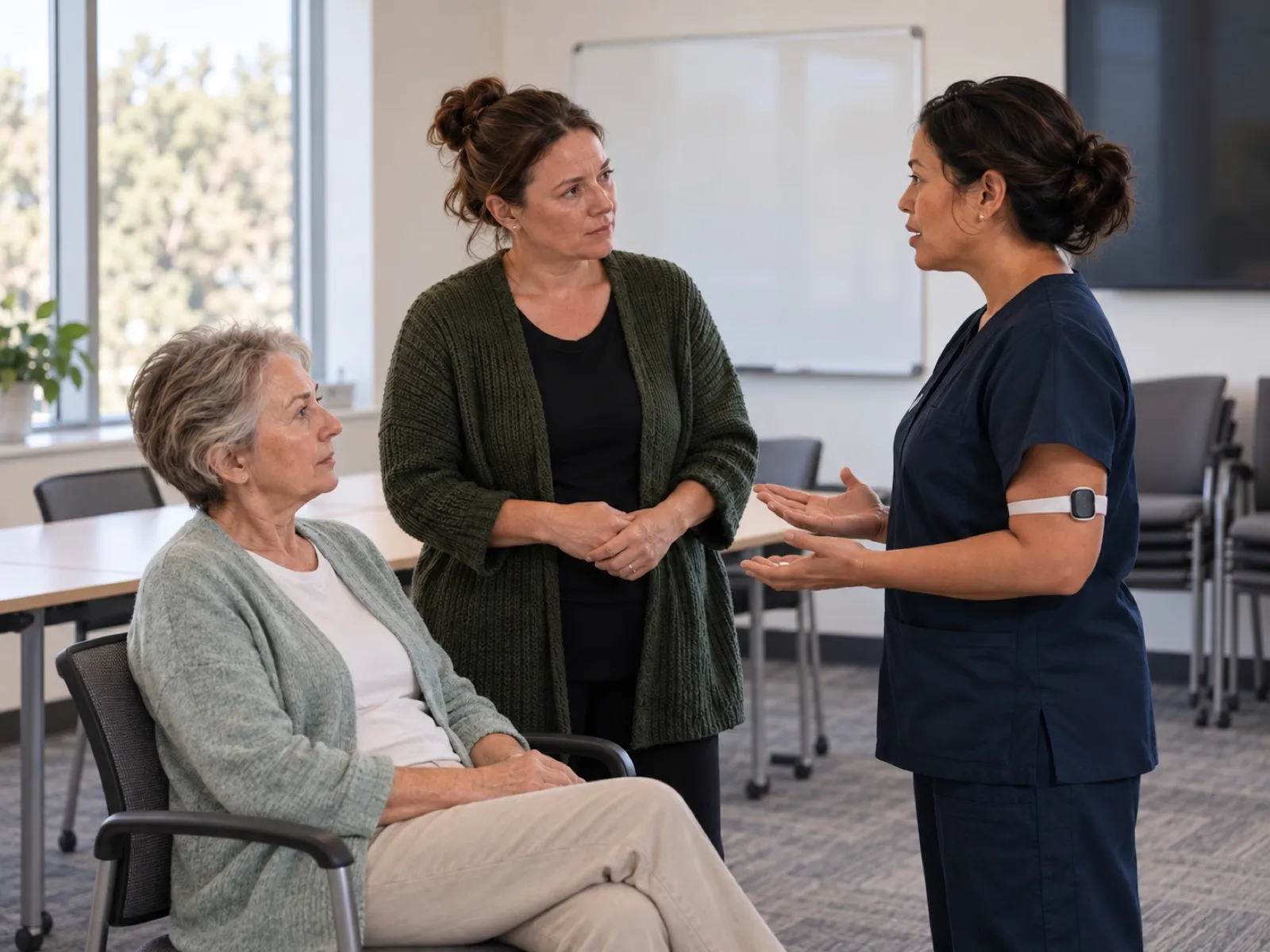
Two actors playing a patient and her daughter with a clinician wearing a biometric armband
For WHS and OVA managers
A program you can point to.

Work-related violence claims are rising in every state. Care Under Pressure gives you a documented, practical intervention for your WorkSafe review, an attendance record for every participant and, with the custom format, measures tied to your own incident data.

Formats

Start with one patient. Add the family when the team is ready.

01

Single Patient Simulation

One day · any ward

A newly admitted patient, played by a professional actor, moves through the day the way patients do: uncertain, in pain, waiting. Staff practise recognising distress early, communicating clearly and de-escalating before it becomes an incident — then watch it back through the patient's eyes and go again.

02

Patient & Family Simulation

One day · advanced

The same patient, plus the family member at the bedside who is frightened, angry or both. Staff learn to hold the room: manage two escalations at once, keep the team aligned and communicate before, during and after the moment.

03

Custom simulation

Scoped with you

Built around your incident data: a specific ward, presentation or time of day. We co-design the scenarios and the measures with your educators and safety leads.

Mental Health First Aid

Give every staff member a first response, not just the specialists.

Lisa Spong is an accredited Mental Health First Aid® Instructor, so alongside the simulation days we deliver accredited Mental Health First Aid courses for your staff: Standard Mental Health First Aid, the Workplace version, and the Conversations About Suicide unit. Participants learn to recognise when someone is developing a mental health problem or is in crisis, and a practical action plan for what to say and do until professional help takes over — whether that person is a patient, a family member or a colleague.

Accredited courses · delivered under licence from Mental Health First Aid Australia · on site, around your roster

Standard Mental Health First Aid

12 hours · face to face or blended

The core course. Staff learn the signs of common mental health problems and crises, and an evidence-based action plan for helping someone until professional support takes over.

Standard Mental Health First Aid for the Workplace

Blended · online learning plus instructor-led sessions

The same action plan, framed for supporting colleagues at work. Online modules fit around shifts, and the instructor-led sessions bring the team together to practise.

Conversations About Suicide

Short unit

A focused unit on recognising warning signs, asking directly about suicide and connecting the person with help. A practical add-on for teams who already have Mental Health First Aid.

Pairs with the simulation day
Learn the action plan. Then practise it.

Mental Health First Aid teaches what to notice and how to respond. A Care Under Pressure simulation day lets staff practise it under pressure, with a patient who feels real. The course gives the shared language; the day builds the reflex.

For WHS and wellbeing leads
Support for colleagues, too.

Staff come away able to support a colleague who is struggling, not only a patient. It is a practical, accredited step towards managing psychosocial risk in your workforce, with a record of who has completed it.

Smart glasses and biometrics

See what the patient saw. Feel what you didn't notice.

The simulated patient wears smart glasses, so each participant reviews their own approach — tone, distance, hands, words — exactly as the patient experienced it. Participants can also wear a biometric armband, so the debrief can show the heart-rate spike that came before the sharp reply. Both are optional; both make feedback specific instead of general.

A debrief group watching a smart-glasses recording on a laptop
Common questions

What managers usually ask us.

Is the Mental Health First Aid course accredited?

Yes. Lisa Spong is an accredited Mental Health First Aid® Instructor and delivers the course under licence from Mental Health First Aid Australia. Participants who complete the course and its assessment can become Accredited Mental Health First Aiders.

Which Mental Health First Aid courses do you run?

Lisa is licensed to deliver Standard Mental Health First Aid, Standard Mental Health First Aid for the Workplace (blended: online learning plus instructor-led sessions) and the Conversations About Suicide unit. We can help you choose the right one for your team.

Can we book Mental Health First Aid on its own?

Yes. Each course runs on its own, or alongside a Care Under Pressure simulation day so staff learn the action plan and then practise it with a patient who feels real.

Can you run it on site, across shifts?

That's how we prefer to do it. We come to your hospital, anywhere in Australia, and schedule around your roster. Travel is quoted separately.

One day. One ward. Measurable change in how staff respond.

Care Under Pressure is scoped and quoted for your service; most wards start with a single simulation day.